
There are medications that affect memory after 60 — and most older adults taking them have no idea. This article covers seven of the most common, what the research shows, and exactly what to ask your doctor.
Her name was Susan. Seventy-three years old. Retired teacher. The kind of person who remembered every student’s name for decades.
Her daughter Sarah noticed it first. Small things, mostly. Susan would start a sentence and forget how it ended. She would walk into a room and stand there, uncertain why she came. She would ask the same question twice in the same hour.
Sarah wrote it down. Fourteen incidents over six months. When they finally saw the doctor, the word ‘decline’ was used.
Sarah cried in the parking lot. Susan didn’t. She said she already knew something was wrong.
Here’s what neither of them knew.
Susan had been taking a sleeping pill every night for four years. Her doctor prescribed it after her husband passed away. It was an act of compassion — it made sense at the time. It just never came up again.
When she stopped — slowly, carefully, under her doctor’s guidance — the fog began to lift. It took months. But it lifted.

Why Your Doctor’s Appointment Doesn’t Cover This
The average primary care appointment lasts twelve minutes. Twelve minutes to cover your history, symptoms, medications, test results, and your questions. There isn’t time to review every medication and everything research has found — not because your doctor doesn’t care, but because the system wasn’t built for that conversation.
I’m Nurse Santos. I’ve spent twenty years caring for older adults and sitting with their families. I made this article — and the video that goes with it — because of the question I hear most often at the bedside:
“Why didn’t anyone tell us this sooner?”
Below, I’ll walk you through seven types of medications that research has connected with memory problems, mental fog, and in some studies, increased dementia risk in adults over 60. For each one, I’ll explain what it does, what the research shows, and what to say to your doctor.
The most important thing I’ll say in this entire article: Do not stop any medication because of what you read here. Always talk to your doctor first. I want you to be informed so you can ask the right questions — and the right questions lead to better care.
1. Sleeping Pills & Anti-Anxiety Medications — Benzodiazepines

You probably know them by their brand names: Xanax, Valium, Ativan, Klonopin. The medical name is benzodiazepine — but the name matters less than understanding what they do.
Think of them as a dimmer switch for your brain. When your thoughts are racing or sleep feels impossible, these medications turn the light down. In the short term — during grief, crisis, or acute anxiety — that can be exactly what someone needs. The concern is long-term use.
Large studies following thousands of older adults over many years have found a connection between long-term use of these medications and up to a 51% higher risk of Alzheimer’s disease. These studies show an association — not a proven cause. But the connection is strong enough that doctors around the world have updated their guidelines because of it.
Susan’s doctor prescribed the medication during her grief. That was the right call at the time. What was missing was the follow-up conversation six months later.
What this means for you: If you or a family member has been taking a sleep aid or anti-anxiety medication for more than a few weeks, that follow-up conversation is worth having.
What to ask your doctor: Ask about alternatives: melatonin works with your body’s natural sleep rhythm. CBT-I (Cognitive Behavioral Therapy for Insomnia) has strong research support and involves no medication at all. Never stop benzodiazepines on your own — they must be tapered carefully under medical supervision.
2. Bladder Medications — Anticholinergics

Thomas was 68 years old and had been taking medication for an overactive bladder for three years. It worked well for that problem. But Thomas noticed he wasn’t quite himself anymore — a little slower, a little foggier.
When he mentioned it to his doctor, he was told: “That’s just your age.” It wasn’t his age.
Thomas was taking oxybutynin — brand names Ditropan or Oxytrol. These medications work by blocking acetylcholine, your brain’s postal service for memories. It carries information from one part of your brain to another when you’re learning or remembering something. It’s so important that Alzheimer’s medications are designed to protect it.
Research has found a connection between these medications and measurably smaller brain volume and lower memory scores in older adults. The longer the use, the stronger the connection.
What this means for you: If you take bladder medication and have noticed mental fogginess, it may not be ‘just getting older.’
What to ask your doctor:
Ask about mirabegron (brand name Myrbetriq). It works differently — it doesn’t block that memory messenger the same way. Thomas switched with his doctor’s guidance. His clarity returned.
3. Some Blood Pressure Medications — Beta Blockers

Beta blockers can be life-saving for heart conditions. This section is not a reason to stop taking yours — it’s a reason to have a specific conversation about which one you’re taking.
Not all beta blockers affect the brain the same way. Some cross your brain’s protective filter — the blood-brain barrier — more easily than others. The ones that enter the brain more readily (like propranolol and some formulations of metoprolol) have been associated with what patients describe as ‘beta blocker brain’: unusual fatigue, low mood, slower thinking.
Carol was 72. Her blood pressure was perfectly controlled. But her family kept saying the same thing: ‘She’s just not herself anymore.’ Her doctor switched her to a different beta blocker — one that doesn’t cross into the brain as easily. Within weeks, her daughter called to say: ‘Mom is back.’
What this means for you: If you started a blood pressure medication and noticed changes in your energy, mood, or thinking afterward, those changes may be connected.
What to ask your doctor:
‘Is there another medication in this class that controls my blood pressure just as well, but has less effect on the brain?’ That question alone opens a door most patients don’t know exists. Never stop blood pressure medication without supervision.
4. Cholesterol Medications — Statins
Statins have some of the strongest evidence in all of medicine for protecting your heart. This is not a reason to stop taking yours.
But the FDA added a note to the official statin label several years ago: some patients may experience reversible cognitive effects while taking statins. The key word is reversible. It doesn’t happen to everyone — but it happens often enough that the FDA required the label change.
David was 70. His doctor was happy with his numbers. But David noticed he was slower at card games, slower with crosswords. He mentioned it at his next appointment. His doctor tried a different statin at a lower dose. The fogginess cleared.
What this means for you: Most people take statins with no effect on their thinking at all. But if you’ve noticed mental changes since starting one, write that down.
What to ask your doctor:
‘I’ve noticed some changes in my thinking since I started this medication — is there room to try a different option or a lower dose?’ Your doctor has more flexibility than you might think.
5. Heartburn Medications — PPIs and H2 Blockers

This is the category that surprises people the most — not because it’s unusual, but because it’s everywhere.
Prilosec, Nexium, Prevacid, and Pepcid are among the most purchased medications in the country. Gloria was 67 and had bought Prilosec every month for four years. She assumed it was safe because it’s on the shelf — no prescription needed.
In one large study, regular long-term use of these acid-reducing medications was associated with about a 44% higher risk of dementia. This type of study shows a connection, not a proven cause — and not every study has found the same result. But the signal is consistent enough to raise the question.
One possible reason involves vitamin B12. Your stomach needs acid to absorb B12 properly. Suppress that acid every day for years, and your body may struggle to get enough of a vitamin your brain depends on.
What this means for you: ‘Available without a prescription’ does not mean ‘safe for daily long-term use after 60.
What to ask your doctor:
‘Do I still need this every day? Could dietary changes reduce my need for it? Is there a lower-dose or as-needed approach that would work for me?’
6. Allergy & Cold Medications — Benadryl and First-Generation Antihistamines

Think about your medicine cabinet right now. There’s probably a box of Benadryl somewhere.
Benadryl blocks the same brain chemical as the bladder medications we discussed — acetylcholine, your brain’s memory postal service. The same mechanism. The same potential concern with regular use.
Research has found that higher long-term exposure to medications in this group has been associated with an increased risk of dementia. The effects can accumulate over time — especially with frequent use. Clinical guidelines now recommend caution with this category for adults over 60.
What this means for you: You don’t have to choose between allergy relief and protecting your brain
What to ask your doctor:
Ask about second-generation antihistamines: loratadine (Claritin), cetirizine (Zyrtec), or fexofenadine (Allegra). These work well for many people and don’t cross into the brain the same way.
7. Over-the-Counter Sleep Aids — ZzzQuil, Unisom, Tylenol PM
The seventh category is in the same family as Benadryl — because in many cases, it is Benadryl. ZzzQuil, Unisom, Tylenol PM, and Advil PM all use diphenhydramine as the active sleep-inducing ingredient. Same compound. Same mechanism. Same concerns.
Millions of older adults reach for these every night — not because they’re being careless, but because sleep is genuinely hard and these are right there on the shelf.
Official clinical guidelines list these medications as potentially inappropriate for adults 65 and older, due to risks including confusion, cognitive impairment, and increased fall risk with regular use.
What this means for you: You don’t have to choose between sleep and protecting your brain.
What to ask your doctor:
Ask about low-dose melatonin, non-medication sleep strategies, or prescription options better suited for older adults. Let your doctor help you find what’s right for you.
Your Action Plan for Medications That Affect Memory After 60
Here’s what I want you to do with everything you’ve read. Don’t panic. Don’t stop anything. Just do this:
Step 1 — Make a List
Write down every medication you take — prescription and over-the-counter. Include sleep aids, allergy pills, heartburn medication, and vitamins. Everything you take regularly. Go through the seven categories above and put a mark next to anything that matches.
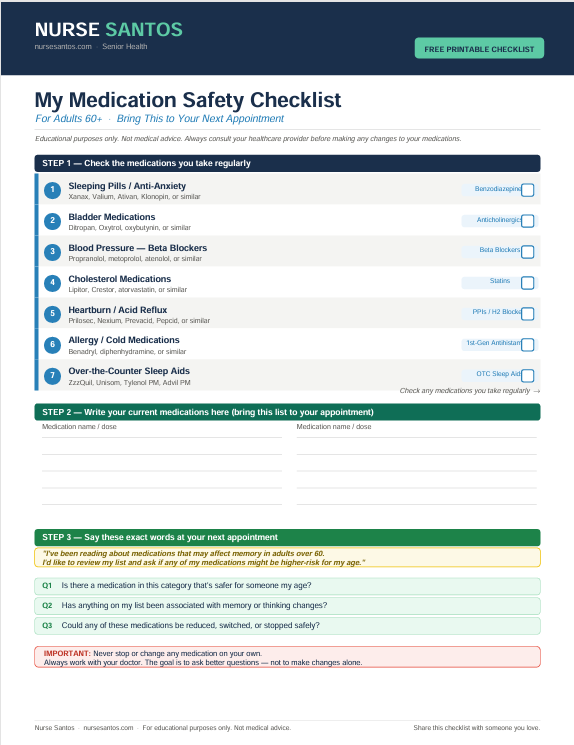
Step 2 — Find Out When and Why
For each medication you marked, find out when it was first prescribed and why. You may discover a medication that was right for a specific season of life — a surgery, a stressful year, a temporary problem — that has simply continued out of habit.
Step 3 — Use These Exact Words at Your Next Appointment
“I’ve been reading about medications that may affect memory and thinking in adults over sixty. I’d like to go through my list and ask whether any of my medications might be higher-risk for someone my age — and if there are alternatives worth considering.”
A good doctor will welcome that question. You’re not asking for immediate changes. You’re asking for a conversation — and that conversation is your right.

Susan’s Story Doesn’t End in That Parking Lot
It continues at a kitchen table on a Tuesday morning, six months after she and her doctor had the conversation her daughter’s list finally made possible.
The medication was tapered carefully. The fog lifted slowly — not dramatically, not overnight. But the names came back. The sentences completed themselves again. She called her former students for the first time in years.
Some cognitive changes have causes that a medication review alone won’t fix. I’m not telling you this to promise a neat ending. I’m telling you this because it started with a list. A daughter paying attention. A question asked at the right moment.
You now have that information.
Always talk to your doctor before making any changes to your medications. The names and stories in this article are composite illustrations based on common clinical experiences. All identifying details are fictional.
If this helped you, share it with someone you love who takes regular medication — not to worry them, but to give them the same thing you now have: a question worth asking.
I’m Nurse Santos. This channel exists because that fifteen-minute appointment doesn’t have time for everything. We do.